Commercial carpet tiles for Warrington offices and care homes: durability and easy replacement between tenancies
Planning commercial carpet tiles in Warrington? We explain spec, subfloor prep and installation so your office or retail floor lasts. Call us today.
Commercial carpet tiles are not all the same, and the difference matters
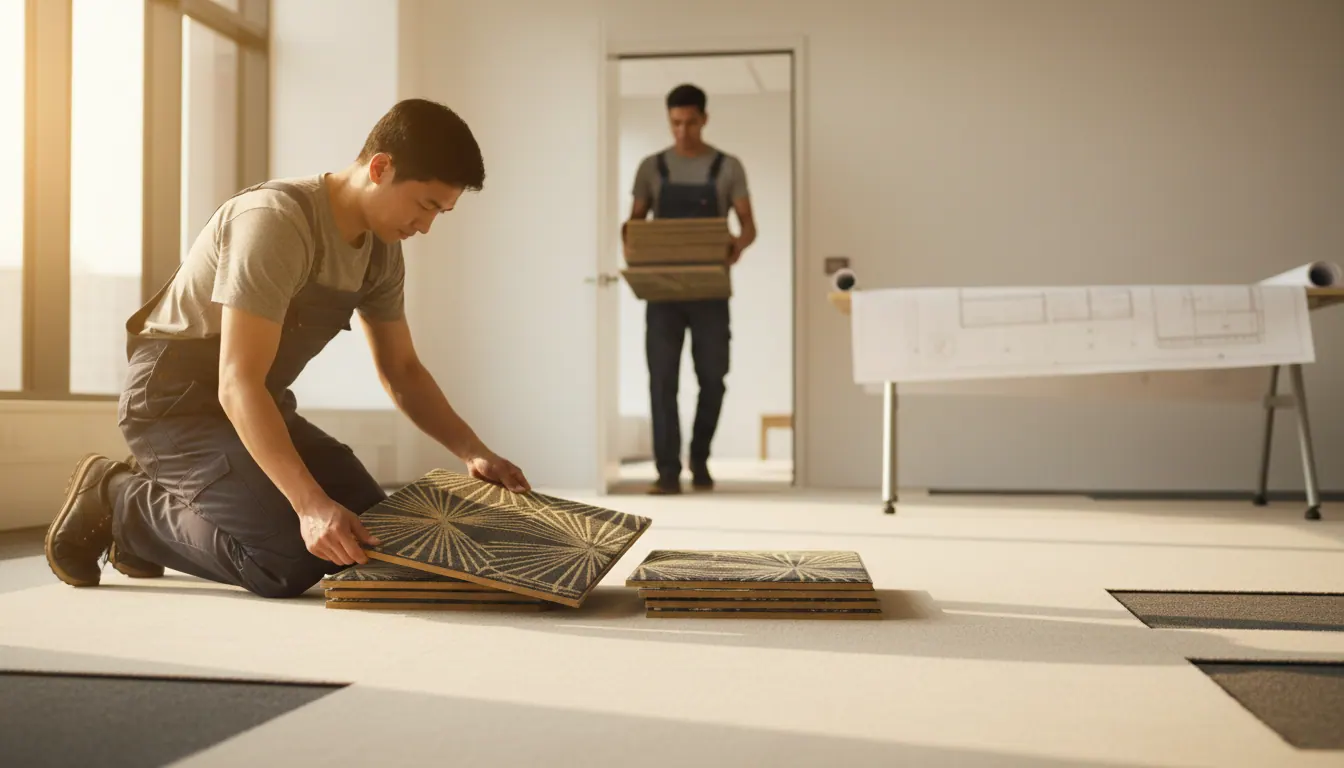
Walk into most offices, schools or retail units across Warrington and you will find carpet tiles underfoot. They are the workhorse of commercial flooring, and for good reason. But the gap between a carpet tile that looks tired within eighteen months and one that still performs after a decade comes down to two things: specification and installation. Getting both right is what we do.
We supply and fit commercial carpet tiles across Warrington and the wider Cheshire area, covering everything from small letting-agent refurbishments in Stockton Heath and Great Sankey through to larger commercial fit-outs in offices, schools and care homes. This article explains what actually goes into a proper commercial carpet tile installation, so you can make a better decision before you spend a penny.
What makes a carpet tile "commercial grade"?
The phrase gets used loosely, so it is worth being precise.
A genuine commercial carpet tile is designed to withstand heavy footfall, rolling loads (office chairs, trolleys, equipment) and the kind of sustained traffic that would destroy a domestic carpet within a year. The key differences from domestic carpet are:
- Pile construction. Loop pile or cut-and-loop tiles resist crushing better than cut pile. In a busy open-plan office or school corridor, a tufted loop pile holds its appearance far longer.
- Backing. Bitumen-backed tiles are the traditional standard. Cushion-backed tiles are thicker and softer underfoot, sometimes used in call centres or spaces where staff stand for long periods. The backing type also affects how the tile is fixed and how it behaves over time.
- Fibre type. Most commercial tiles use nylon or polypropylene. Nylon is more resilient and takes cleaning well. Polypropylene is harder-wearing against staining but can flatten under sustained load.
- Tile size. The standard is 500 mm × 500 mm. Some ranges offer 600 mm × 600 mm or plank formats, which can change the look significantly.
None of this is about brand names or showroom appeal. It is about matching the specification to what the floor actually has to do. A care home corridor needs a different spec from a boutique office in Latchford or a school in Padgate.
Subfloor preparation: the step most people underestimate
We say this in almost every article we write, because it is the single most common reason a commercial floor fails early. Why subfloor preparation makes or breaks your new flooring in a Warrington extension covers the detail for domestic settings, but the principle is identical in commercial spaces, and often more critical because the floor takes so much more use.
Carpet tiles are unforgiving of an uneven subfloor. A lump or dip of even a few millimetres will cause tiles to rock, edges to lift and joins to show. In a busy office, lifted tile edges become a trip hazard. In a retail unit, they look unprofessional within weeks.
Before we lay a single tile, we assess the subfloor properly. That typically means:
- Checking for moisture, because a damp concrete subfloor will destroy adhesive and cause tiles to bubble or delaminate. Moisture testing is not optional.
- Grinding down high spots and filling low spots with a floor-levelling compound. The compound needs time to cure correctly before anything goes on top of it.
- Checking that the surface is clean, sound and free of contamination. Old adhesive, paint or debris all affect the bond.
This part of the job is not glamorous, but it is where the quality of the finished floor is decided. A good tile on a poor subfloor will not perform. A good tile on a properly prepared subfloor will last years.
Setting out: why where you start matters
Commercial carpet tiles are almost always laid in a grid pattern, and the starting point of that grid determines how the finished floor looks. Get it wrong and you end up with narrow cut tiles down one side of the room, or a pattern that looks visually off-centre.
The correct approach is to set out from the centre of the room, working outward so that any cut tiles at the perimeter are equal in width on opposite sides. In rooms with fixed furniture, columns or feature walls, the set-out needs to account for those too.
In large open-plan spaces, such as an office floor across a building in Chapelford or a school hall in Warrington town centre, the setting-out process is more involved. You are working across a bigger area, potentially with irregular walls, doorways and structural elements to account for. Getting it right takes time. Rushing it shows.
Fixing methods: tackifier, full adhesive or free-lay?
Not all carpet tiles are glued down fully. There are three main approaches:
Free-lay works in some situations where tiles interlock tightly and the floor area is large enough that the tiles hold each other in position. It is rarely the right choice in a busy commercial environment.
Tackifier adhesive is a pressure-sensitive adhesive that holds tiles in place but allows them to be lifted and replaced individually. This is the most common method in offices and commercial spaces because it makes replacing a damaged or stained tile straightforward without disturbing the rest of the floor.
Full adhesive is used where tiles need to be permanently bonded, often in high-traffic corridors, entrance areas or where the subfloor specification demands it.
The right fixing method depends on the tile backing, the subfloor type, the expected traffic and whether the client needs to access underfloor services (cable management, for example). We will advise on this before the job starts, not after.
What our customers say
We fitted hard flooring and carpet across an entire property for one customer recently. Tom, who left us a review, put it plainly:
The best around! Did our whole house, hard flooring & carpet, and were brilliant throughout
That was a domestic job, but the craft is the same whether we are fitting carpet tiles in a Warrington office or carpet on a staircase in Stockton Heath. Attention to detail, clean workmanship, and a floor that looks right when we leave.
Commercial carpet tiles for different settings
Different commercial environments have different demands. Here is how we think about specification for the most common ones:
Offices. The priority is appearance retention under office chairs and foot traffic. Loop pile tiles with a good abrasion rating, laid with tackifier adhesive so individual tiles can be swapped out if one area wears faster or gets stained.
Schools and education. Acoustic performance matters here as much as durability. Tiles with a cushion backing can help reduce noise in classrooms and corridors. They also need to be easy to clean and resistant to the kind of heavy, concentrated use that comes with a full school day.
Care homes. Comfort underfoot, ease of cleaning and appearance retention are all important. Some care homes also have requirements around slip resistance in certain areas, though for wet areas we would always recommend sheet vinyl or safety vinyl rather than carpet tiles.
Retail units. First impressions count. The tile needs to look good on day one and continue to look good through a busy trading week. Entrance areas often need a harder-wearing spec than the main floor area, and sometimes a different product entirely.
Landlords and letting agents. Between tenancies, a fast turnaround matters. We work with landlords and agents across Warrington, Latchford and Great Sankey who need a commercial-grade floor fitted efficiently with minimal disruption to their schedule.
Frequently asked questions
Can you still buy carpet tiles, or has LVT taken over?
Carpet tiles are very much still available and widely used in commercial settings across Warrington and Cheshire. LVT has grown in popularity, particularly in kitchens, hallways and wet areas, but for offices, schools and care homes, commercial carpet tiles remain the specification of choice for many clients. They offer acoustic benefits and underfoot comfort that hard flooring cannot match.
What is the typical thickness of a commercial carpet tile?
Most commercial carpet tiles fall between 6 mm and 10 mm in total thickness, including the backing. The pile height alone is usually 3 mm to 6 mm depending on the construction. Cushion-backed tiles sit at the thicker end of the range. Thickness affects how the tile performs underfoot and how it transitions to adjacent flooring at doorways, which is something we always plan for during installation.
Is carpet or carpet tiles better for a commercial space?
Broadloom carpet (fitted carpet in rolls) can work well in some commercial settings, particularly hospitality and hotels. But for most offices, retail units and schools, carpet tiles have a clear practical advantage: if one tile is damaged or heavily stained, you replace just that tile rather than a whole section of floor. They are also easier to fit around complex room shapes and to refit after access to underfloor services.
How does the cost of commercial carpet tiles compare to other flooring options?
We do not quote prices in articles because cost depends on the room size, the tile specification, the condition of the subfloor and the complexity of the installation. What we will say is that carpet tiles are often chosen partly because the ongoing maintenance cost is lower than broadloom carpet. A single replacement tile is straightforward and inexpensive. Get in touch and we can discuss what is right for your space and give you a proper quote.
Ready to talk about your commercial floor?
If you are planning a commercial flooring project in Warrington, whether that is an office in the town centre, a retail unit in Stockton Heath or a school in Padgate, we are happy to come and look at the space before you commit to anything. No obligation, no hard sell. Just an honest assessment of what the floor needs and what will work best.
Call us on 07946 765568 and let's talk about your project. Your floor, our signature.