Why sheet vinyl flooring fails in Warrington restaurants: common mistakes in seaming and prep that lead to water damage
Sheet vinyl failing in your Warrington restaurant or commercial kitchen? We explain the real causes and how correct fitting prevents problems from day one.

Why sheet vinyl fails in Warrington restaurant and commercial kitchen floors
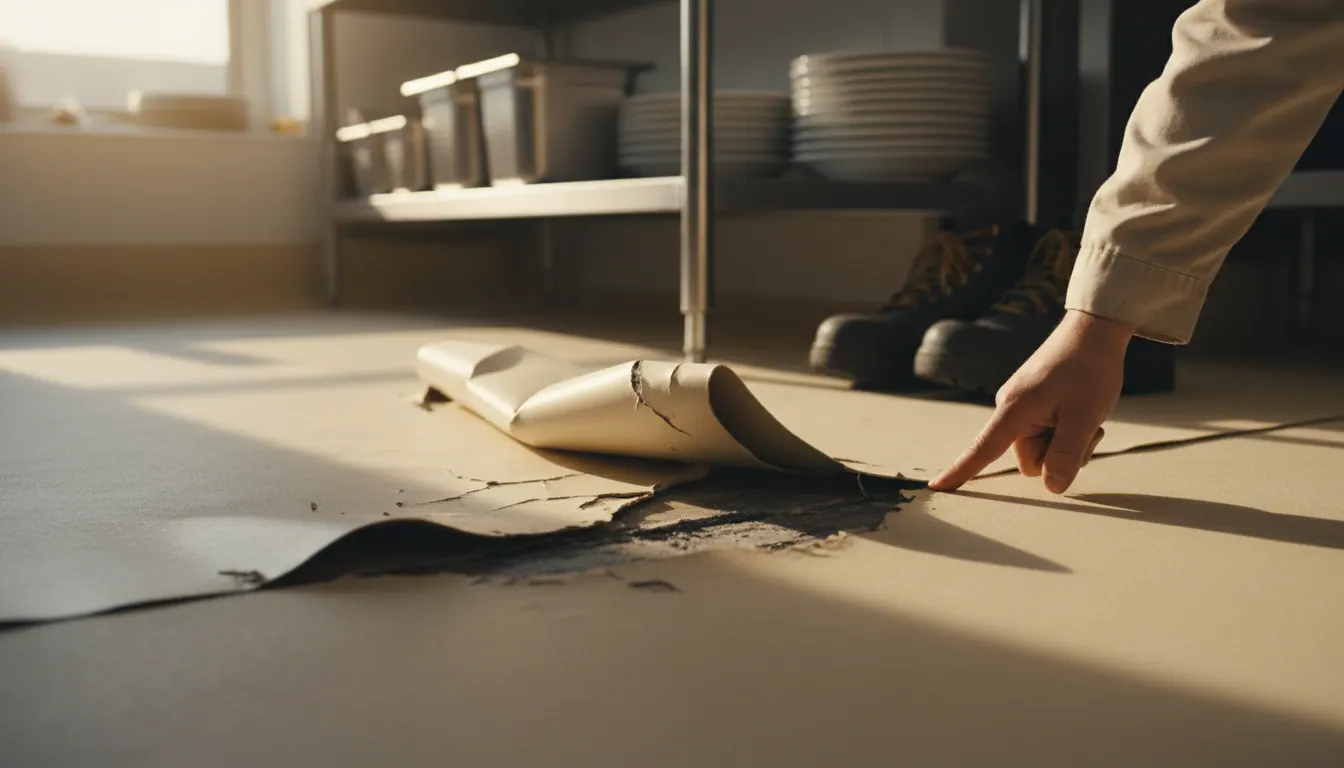
A sheet vinyl floor that starts lifting, bubbling or splitting within months of fitting is not a material problem. It is almost always a preparation and installation problem. We see this regularly across commercial premises in Warrington, from high-footfall restaurant dining rooms to busy back-of-house kitchen areas, and the causes are consistent.
Getting it right from the start is not complicated, but it does require patience, the right products and a clear understanding of what a commercial kitchen or restaurant floor actually has to endure.
The real causes of sheet vinyl failure in commercial settings
1. Subfloor preparation cut short
This is the most common reason a sheet vinyl floor fails. A restaurant floor sees constant foot traffic, heavy equipment being moved, trolleys, dropped items and spillages. Any unevenness in the subfloor, no matter how slight, will telegraph through the vinyl over time. You will see ridges appearing, edges starting to lift and, eventually, the vinyl cracking along stress lines.
Concrete subfloors in older Warrington commercial premises, particularly those in converted Victorian or Edwardian buildings, are rarely flat. They need grinding down at high spots and filling with a quality floor-levelling compound before any vinyl goes down. We never cut corners when it comes to preparation. The time spent levelling is what determines whether the floor still looks good in five years.
Timber subfloors need checking for flex and movement too. A springy floor will break adhesive bonds over time, no matter how good the vinyl itself is. Where boards move, they need securing before fitting.
For more on why this stage decides the outcome of any flooring project, our article on why subfloor preparation makes or breaks your new flooring in a Warrington extension covers the principles in detail, and the same logic applies directly to commercial premises.
2. Seams and joints not properly sealed
In a restaurant or commercial kitchen, water, grease and cleaning chemicals are on the floor constantly. A seam that is not heat-welded or chemically sealed is an open invitation for liquid to get underneath the vinyl. Once moisture gets beneath the sheet, the adhesive bond breaks down, the vinyl lifts, and you have a hygiene problem as well as a flooring problem.
Sheet vinyl for commercial kitchens should be fitted with fully sealed joints. That means heat-welding the seams so the floor becomes, in effect, a single continuous waterproof surface. This is not optional in a food preparation environment; it is the standard that keeps the floor performing and keeps it compliant with hygiene requirements.
We cover this in more detail in our article on sheet vinyl flooring for Warrington commercial kitchens and restaurants: why sealed joints prevent water ingress.
3. Wrong adhesive or incorrect adhesive coverage
Not all adhesives suit all subfloors or all vinyl products. Using a general-purpose adhesive on a commercial sheet vinyl, or applying it too thinly, will result in areas that never fully bond. Those weak spots become the first places to lift when the floor is under stress.
In areas that see steam, wet mopping or frequent hosing down, the adhesive needs to be appropriate for wet conditions. We specify the right adhesive for each job based on the subfloor type, the vinyl specification and the environment it will be used in.
4. Acclimatisation ignored
Sheet vinyl needs time to acclimatise to the temperature of the room before it is fitted. Roll it out cold from a van in January and fit it straight away, and it will expand slightly once the kitchen reaches operating temperature. That expansion has to go somewhere. It goes into bubbles and ripples.
In a working restaurant, this matters more than in a domestic setting because the temperature swings can be significant. A kitchen running at full service is a warm, humid environment. The vinyl needs to be given time to reach equilibrium before the adhesive is applied.
5. Sheet vinyl specified at too light a gauge for the use
Commercial kitchens and restaurant front-of-house areas are not domestic settings. A vinyl specified for a light commercial or residential use will wear through quickly under heavy restaurant traffic. Castors on chairs, constant foot traffic, dropped equipment and cleaning machinery all demand a product specified for the actual use.
We advise on the right specification for each environment. A dining room with fixed furniture has different demands from a kitchen where heavy equipment is regularly moved. Getting the specification right at the outset saves the cost and disruption of an early replacement.
What good sheet vinyl installation looks like in a Warrington commercial kitchen
Done properly, the process looks something like this:
- Subfloor assessed: concrete checked for moisture, timber checked for flex and movement
- High spots ground down, low spots filled with a levelling compound appropriate to the load the floor will carry
- Adhesive selected to match the subfloor and the vinyl product
- Vinyl unrolled and left to acclimatise in the room at operating temperature
- Adhesive applied at the correct coverage rate, across the full area, with no dry spots
- Vinyl laid and rolled to ensure full contact
- All seams heat-welded to create a continuous, waterproof surface
- Edges coved up the wall where specified, to eliminate the gap between floor and wall
The result is a floor that can be cleaned down properly, resists moisture ingress and holds up under the daily demands of a working kitchen or restaurant.
What our customers say
Exceptional work and craftsmanship, would recommend to anybody
That is from Brad, one of our customers. It is short, but it reflects what we aim for on every job: work that speaks for itself.
Safety vinyl and slip resistance in restaurant environments
A restaurant kitchen floor has to be slip-resistant, not just waterproof. Sheet safety vinyl with an R-rated or wet-area slip-resistance classification is the appropriate choice for kitchen floors where water and grease are present. This is a different product from standard sheet vinyl and it is specified differently.
Front-of-house dining areas have different requirements, but slip resistance still matters, particularly near entrances where wet footwear is brought in from outside. We specify the right product for each zone of the premises.
For care homes and healthcare settings where similar hygiene and slip-resistance requirements apply, our article on safety vinyl flooring for Warrington care homes and healthcare settings: slip resistance and infection control explains the principles in more detail.
Planning a refit around a working restaurant
One of the practical challenges with commercial flooring in Warrington is fitting the work around trading hours. A restaurant cannot close for a week. We plan jobs to minimise disruption, working in sections or overnight where that suits the business.
The subfloor preparation stage is often the most time-sensitive part. Levelling compounds need curing time before the vinyl goes down, and that has to be factored into the schedule. Rushing that stage to meet a deadline is how failures start.
If you are planning a refit, talk to us early. The more lead time we have, the better we can plan around your trading pattern.
Frequently asked questions
Why is my restaurant floor bubbling or lifting so soon after fitting?
The most likely causes are inadequate subfloor preparation, insufficient adhesive coverage or vinyl that was not given time to acclimatise before fitting. In a commercial kitchen, moisture getting beneath unsealed seams is also a common cause. Each of these is a preparation or installation issue, not a fault with the vinyl itself when correctly specified.
Does sheet vinyl in a commercial kitchen need heat-welded seams?
Yes, in almost every case. An unsealed seam in a kitchen environment allows water, grease and cleaning chemicals to penetrate beneath the vinyl. Over time this breaks down the adhesive bond and creates a hygiene risk. Heat-welding the seams creates a continuous waterproof surface, which is the correct standard for a food preparation area.
Can sheet vinyl be fitted on an old concrete floor in a Warrington commercial premises?
Yes, but the concrete needs to be assessed and prepared first. Old concrete in Warrington's commercial and industrial buildings is often uneven, contaminated with old adhesive or affected by moisture. It needs grinding, priming and levelling before any vinyl is fitted. Skipping this stage is the most common reason commercial vinyl floors fail.
How do I get a quote for sheet vinyl in my restaurant or commercial kitchen in Warrington?
We quote each job individually once we understand the space, the subfloor condition and the specification needed. Get in touch and we will arrange a visit to assess the premises properly before giving you a price.
Ready to sort your commercial floor?
If you have a sheet vinyl floor that is failing, or you are planning a new installation in a restaurant, commercial kitchen or any other commercial premises across Warrington and the surrounding area, we are happy to take a look. We have over 30 years of experience in the flooring industry and we understand what these environments demand.
Call us on 07946 765568 and we will arrange a time to come and see the job properly.
Thinking about a new floor?
Call us- Why subfloor preparation makes or breaks your new flooring in a Warrington extension
- Sheet vinyl flooring for Warrington commercial kitchens and restaurants: why sealed joints prevent water ingress
- Safety vinyl flooring for Warrington care homes and healthcare settings: slip resistance and infection control