Carpet fitting on stairs in a Warrington home: why the underlay and seaming matter for safety and wear
Fitting carpet on stairs in Warrington homes? We explain pile types, safety, subfloor prep and what actually wears well. Supply and fit across Warrington.

Why stairs are the hardest-working floor in your home
Stairs take a pounding that no other surface in the house matches. Every trip up and down concentrates wear on the same strip of carpet, right at the nosing edge where the tread meets the riser. In a busy Warrington household, a 1930s semi in Padgate, a Victorian terrace in Latchford, a new-build in Chapelford, that adds up fast. Get the carpet choice wrong and you will see bald patches and fraying nosings within a few years. Get it right and a well-fitted stair carpet looks sharp and stays safe for a decade or more.
We have fitted carpet on stairs across Warrington for over 30 years. This article explains what actually matters: pile type, weight, backing, and the preparation work underneath that most people never think about until something goes wrong.
What type of carpet wears best on stairs?
The short answer is a dense, low-pile carpet with a hard-twist or loop construction. Here is why.
Twist pile is the most popular choice for stairs and with good reason. The fibres are tightly twisted together, which means they spring back after being compressed underfoot. A good-quality twist pile in a heavy domestic or contract grade holds its appearance far longer than a soft, deep-pile carpet that flattens at the nosing within months.
Loop pile (Berber-style) can work well on stairs if the loops are tight and the weight is sufficient. Avoid open, chunky loops: they snag on heels and can present a trip hazard over time, particularly on the nosing.
Cut-and-loop and saxony piles are better suited to bedrooms and living rooms. They look luxurious on the flat, but on a stair tread the uneven surface wears inconsistently and shows footprints and scuffs much more quickly.
A few things to look for when choosing:
- Fibre: 80/20 wool-mix or a good-quality nylon performs well on stairs. Pure polypropylene tends to flatten faster under repeated point-loading.
- Pile weight: for stairs, you want a higher face weight. A heavier pile means more fibre per square metre and a longer lifespan.
- Backing: a firm, dense backing holds its shape when the carpet is pulled tight over the nosing and gripper.
We are happy to talk you through the options when you get in touch. We do not push any particular brand, just honest advice on what suits the room, the traffic and the subfloor.
What to avoid when buying carpet for stairs
A few things catch people out:
Buying on softness alone. The softest carpet in the shop is almost never the right choice for stairs. Soft equals low-density, and low-density equals fast wear at the nosing.
Ignoring pile direction. Carpet has a direction. Fitted correctly, the pile leans away from you as you walk up the stairs, which looks better and wears better. Fitted the wrong way, the pile catches the light oddly and wears faster.
Underestimating the underlay. A good stair underlay is not optional. It cushions each step, reduces wear on the carpet backing, and adds grip. On a steep staircase in an older Warrington property, it also makes a real difference to how safe the stairs feel underfoot.
Skipping the nosing detail. The nosing is where the tread meets the riser. Carpet fitted loosely or without proper gripper at the nosing will lift, creating a genuine trip hazard. We never rush this stage.
Subfloor and stair preparation: the bit that decides the finish
A staircase is not a flat floor. Each tread and riser is a separate surface, and in older properties, particularly Victorian terraces in Latchford or Woolston, or 1930s semis across Orford and Great Sankey, the treads may be uneven, squeaky or slightly warped.
Before we lay a single strip of carpet, we check:
- Gripper placement. Gripper rod goes on the tread and up the riser, set back from the nosing by the thickness of the underlay. Positioning matters: too close to the edge and the carpet lifts; too far back and you get a visible gap.
- Squeaks and movement. A loose tread that moves underfoot will work the carpet loose over time. Where there is movement, we address it before fitting. Fixing squeaky treads is a joinery job if structural work is needed, but we make sure the surface we are fitting to is solid.
- Nosing condition. Rounded or chipped nosings on older stairs need to be considered when choosing underlay thickness and carpet weight. The carpet has to wrap cleanly without bunching.
If your stairs are part of a larger project, a new extension, a knock-through, or a full house refurral, the prep on the stairs is just as important as anywhere else. We wrote in more detail about subfloor preparation in our article on why subfloor preparation makes or breaks your new flooring in a Warrington extension, and the same principles apply here.
Fitting carpet on stairs: why the craft matters
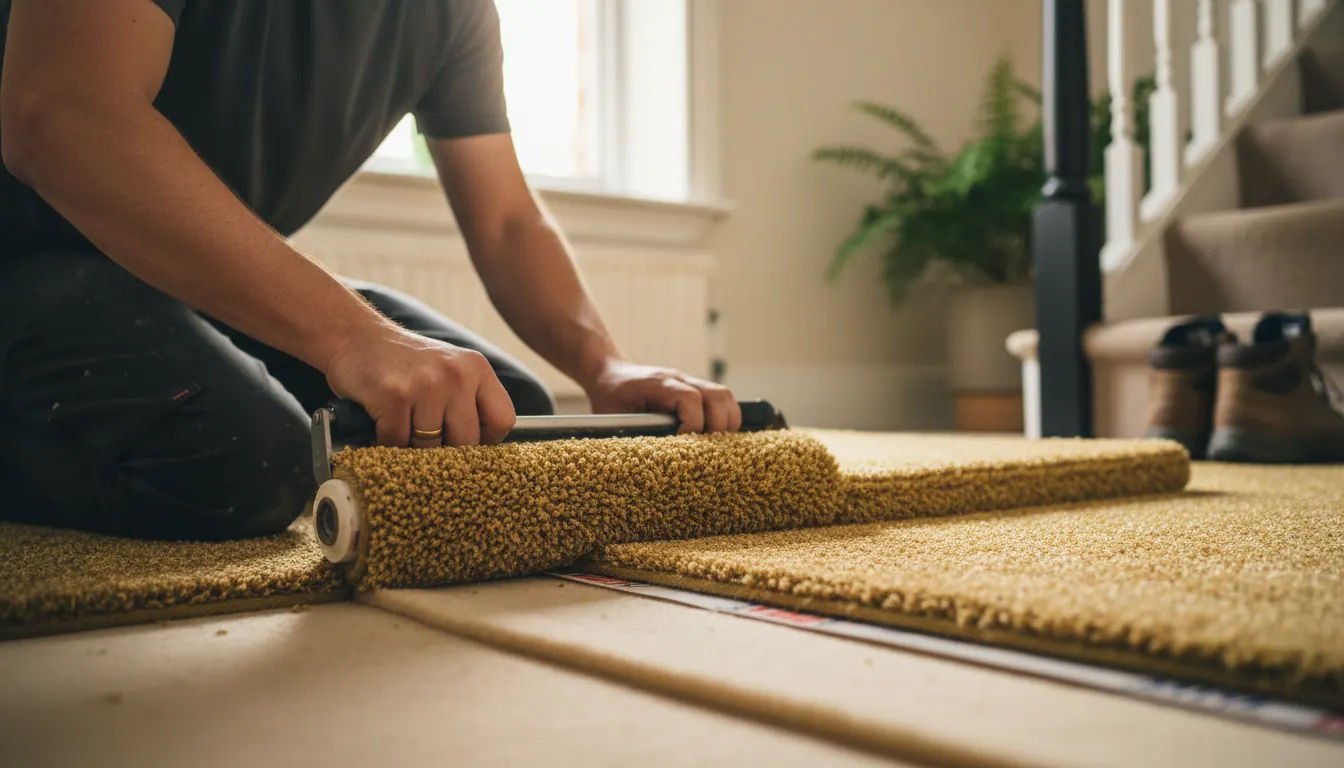
Stair carpet fitting is one of the more skilled tasks in our trade. The carpet has to be cut and folded precisely at every riser, pulled tight at every nosing, and tucked cleanly into the angle between tread and riser without puckering or gapping.
On a straight flight it is methodical work. On a winding staircase with a quarter-landing, or a dog-leg flight common in a lot of Warrington's 1930s housing stock, it requires careful cutting and pattern-matching if you are using a carpet with a directional design or a stripe.
We work through the whole staircase as a single job, not tread by tread as an afterthought. The result is a finish that looks intentional, sits flat, and holds its position.
Jessica, one of our customers, put it simply:
Amazing work as always off Harry & Cliff. Perfectionists and so quick! Would always always use them and highly recommend! Couldn't be happier with our new flooring we love it so much.
That attention to detail is what we bring to every job, whether it is a single staircase or a whole house.
Carpet stairs as part of a wider flooring project
Many of our customers in Warrington come to us needing flooring throughout the house, not just on the stairs. Hard flooring downstairs, carpet on the stairs and landing, perhaps a mix of materials across different rooms. Planning the transition between those materials is something we think about from the start.
If you are fitting LVT in the hallway and carpet on the stairs, the threshold detail at the bottom step matters. Get it wrong and it looks untidy and can become a trip hazard. We cover the planning side of mixed-floor projects in our article on carpet and LVT flooring together: how to plan the transition between rooms in a Warrington home.
Tom, another customer, summed up what it is like when the whole house comes together:
The best around! Did our whole house, hard flooring & carpet, and were brilliant throughout.
We supply and fit across Warrington and the surrounding area in Cheshire, covering domestic homes in every district of the town as well as commercial premises. If your project involves stairs alongside other rooms, we look at it all together.
Frequently asked questions
What type of carpet wears best on stairs in a busy family home? A dense, hard-twist pile in a heavy domestic or contract grade is the most durable choice. Look for a tight construction, a firm backing, and a face weight suited to high-traffic use. Wool-mix and quality nylon fibres both perform well. Avoid soft, deep-pile or saxony carpets on stairs: they flatten quickly at the nosing and show wear fast.
What should I avoid when buying carpet for stairs? The main things to avoid are: choosing carpet based on softness rather than density; ignoring pile direction during fitting; skimping on underlay; and not paying attention to how the nosing is finished. A loose or poorly fitted nosing is a safety issue, not just an aesthetic one. We take the time to get each of those details right.
Do I need a special underlay for stairs? Yes. Stair underlay is cut to fit each individual tread and is firmer than standard room underlay. It needs to be positioned correctly so the carpet can wrap cleanly over the nosing. The right underlay reduces wear on the carpet backing, adds comfort underfoot, and improves grip, which matters on a steep flight.
Can carpet be fitted on stairs in an older Warrington property with uneven treads? Yes, but the preparation stage is important. Uneven or squeaky treads need to be assessed before fitting. Where treads have movement or structural issues, that is a job for a joiner before we start. Once the surface is solid, we can fit carpet to achieve a clean, flat finish even on older staircases with character quirks.
Ready to talk about your stairs?
Whether you need carpet on a single staircase or you are planning flooring throughout your home, we are happy to take a look and give you honest advice. We cover Warrington and the surrounding area in Cheshire, from Great Sankey and Grappenhall to Woolston, Padgate and beyond.
Call us to arrange a visit and we will talk through what suits your stairs, your household and your subfloor. Your floor, our signature.